In the study of the intriguing world of M. De St.-Germain, a mysterious figure who navigated the realms of Enlightenment-era Europe, engaging with prominent thinkers, rulers, and esoteric traditions. Through an examination of his relationships and associations, this analysis reveals an intricate system of philosophical and spiritual influences, highlighting the intersections of rationalism, mysticism, and the human experience.
Historical & Symbolic Context
At the center of this inquiry lies the enigmatic M. De St.-Germain, a figure shrouded in mystery, yet connected to a vast network of influential individuals and esoteric concepts. His associations with prominent thinkers such as Voltaire, Frederick the Great, and Horace Walpole demonstrate his immersion in the intellectual currents of the Enlightenment. However, his connections to the Knights Templar, telepathy, and supernatural abilities reveal a more esoteric and mystical dimension to his persona.
The phrase "to the manner born" serves as a poignant descriptor of M. De St.-Germain's life, suggesting a natural aptitude for navigating the complexities of high society and the esoteric realms. His alleged telepathic abilities, allowing him to "feel" the need of his presence in distant cities, demonstrate the notion that he operated on a unique plane of consciousness. This is further reinforced by his capacity for "appearance without the door," a supernatural ability that transcends the bounds of physical reality.
De St.-Germain's relationships with rulers such as Peter III and the Shah of Persia highlight his involvement in the intrigue-ridden world of 18th-century politics. Yet, his associations with Una Birch, who chronicled his travels, and Horace Walpole, with whom he exchanged conversations, suggest a more nuanced and human side to his persona.
The connections between M. De St.-Germain and the Knights Templar, though disputed, introduce a fascinating thread of esotericism into the narrative. This order, founded in the 12th century, embodied a unique blend of martial prowess and spiritual zeal. The potential link between M. De St.-Germain and the Templars raises intriguing questions about the transmission of esoteric knowledge and the evolution of mystical traditions.
The figure of M. De St.-Germain serves as a cipher for the sympathy of Enlightenment rationalism and esoteric mysticism. His life and associations demonstrate that the pursuit of knowledge and understanding is often a manifold and interdisciplinary endeavor, embracing both the rational and the mystical. Through the lens of M. De St.-Germain, we catch a glimpse of a world where the boundaries between the rational and the esoteric are blurred, and the human experience is revealed in all its complexity and richness.
Bibliographia & Fontes
Primary Source Books Used in This Article
The doctrines, historical citations, and symbolic correspondences synthesized in this article are drawn from the following primary works and chapters:
- I.Manly P. Hall, The Secret Teachings of All Ages1928
An Encyclopedic Outline of Masonic, Hermetic, Qabbalistic and Rosicrucian Symbolical Philosophy
Chapters / Sections Consulted:Ch. “The Mysteries and Their Emissaries”
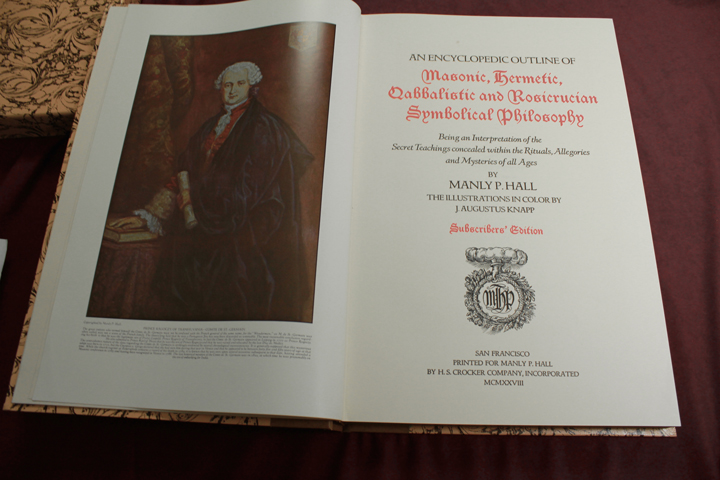
The Secret Teachings of All Ages (Manly P. Hall — Reader’s Edition)
An encyclopedic outline of Masonic, Hermetic, Qabbalistic, and Rosicrucian symbolical philosophy, detailing the rites of ancient mystery schools from Eleusis to the Rose Cross.