The Hiram tradition reveals an intricate system of esoteric concepts, entities, and relationships that, when synthesized, unveil a profound philosophical narrative. Central to this narrative is the figure of Hiram, the Master Builder, who embodies the evolution of human civilization and the dynamic interplay between state, church, and the common people.
The Master Builder: Hiram and the Tyrian Grand Master
Hiram, as a historical figure and philosophical symbol, holds a manifold role in the narrative of this hermetic lineage. As the Master Builder, he is identified with the Tyrian Grand Master, Chiram Abiff, who represents a world-wide organization of artisans. This relationship underscores Hiram's connection to the laws and secrets of architecture, which are symbolized by Masonic marks and abstract ideals. The Tyrian Grand Master, as an embodiment of Hiram, signifies the mastery of universal laws and the transmission of esoteric knowledge.
Pagan Mysteries and the Evolution of Human Civilization
Hiram's association with pagan mysteries personifies philosophy itself, highlighting the struggles and progress inherent in societal development. This relationship is set against the backdrop of conflicts between state, church, and the common people, illustrating the dynamic interplay between these figures and symbols. The pagan mysteries, preserved by early Freemasonry, represent a body of knowledge that has been passed down through the ages, influencing the development of human civilization.
Masonic Marks and Architectural Ideals
Masonic marks, found on buildings in various regions, symbolize the dedication of labor to the Supreme Architect of the Universe. These marks, as interpreted by S. Zola, hold Masonic significance and are connected to the abstract ideals of architecture. The relationship between Masonic marks and architectural ideals affirms that these symbols embody the divine principles that govern the universe. The Master Mason, through the interpretation of these marks, can release these principles, resurrecting the abstract ideals of architecture.
Harmony and Understanding: The Ultimate States of Consciousness
Harmony and understanding, as the ultimate states of consciousness, symbolize the transmutation of ignorance, superstition, and fear into wisdom, faith, and love. These states are embodied by Hiram, who represents the synthesis of spiritual and material states. The relationship between harmony and understanding and architectural ideals highlights the notion that the practical structures of architecture can be transformed by the Craft's philosophy, reflecting the ultimate states of consciousness.
Hiram
In synthesizing the principles and correspondences within this esoteric current, a profound philosophical narrative emerges. Hiram, as the Master Builder, embodies the evolution of human civilization and the dynamic interplay between state, church, and the common people. The pagan mysteries, preserved by early Freemasonry, represent a body of knowledge that has been passed down through the ages, influencing the development of human civilization. Masonic marks and architectural ideals symbolize the dedication of labor to the Supreme Architect of the Universe and the embodiment of divine principles. The synthesis of this hermetic lineage reveals a harmonious narrative that demonstrates the transmutation of ignorance, superstition, and fear into wisdom, faith, and love.
Bibliographia & Fontes
Primary Source Books Used in This Article
The doctrines, historical citations, and symbolic correspondences synthesized in this article are drawn from the following primary works and chapters:
- I.Manly P. Hall, The Secret Teachings of All Ages1928
An Encyclopedic Outline of Masonic, Hermetic, Qabbalistic and Rosicrucian Symbolical Philosophy
Chapters / Sections Consulted:Ch. “The Hiramic Legend”
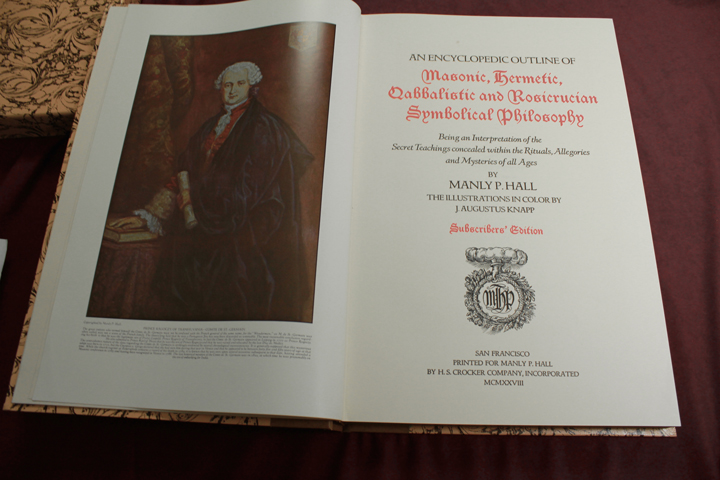
The Secret Teachings of All Ages (Manly P. Hall — Reader’s Edition)
An encyclopedic outline of Masonic, Hermetic, Qabbalistic, and Rosicrucian symbolical philosophy, detailing the rites of ancient mystery schools from Eleusis to the Rose Cross.