The analysis reveals a harmonious framework where reason serves as a fundamental faculty for understanding and applying intellectual and moral principles, ultimately leading to the attainment of eternal life. The universal religion, grounded in reason and simplicity, provides a rational basis for understanding the world and our place within it.
The Primacy of Reason
Reason is established as a primary faculty of the mind, enabling individuals to think logically and rationally. It is described as a tool for unfolding numbers and ideas, facilitating progress in intelligence and understanding truths about existence and harmony. The relationship between reason and the word of reason is particularly significant, as reason gives rise to the word of reason, which is omnipotent and analogous to the word of God. This implies that reason has the power to shape and direct human will, leading to the attainment of eternal life.
Eternal Life and the Cosmos
Eternal life is symbolized by the Cross and fixed stars, representing an eternal and unending life that transcends the temporal nature of the universe. The path of the comet, determined like fixed stars but temporary and consuming, serves as a metaphor for the fleeting nature of life. In contrast, fixed stars offer peace and represent permanent, calm, and tranquil life. The relationship between eternal life and experiences from past lives highlights the continuity of existence, where experiences from past lives contribute to the growth and progression of the individual.
Universal Religion and Simplicity
The universal religion is described as an infallible and universally applicable belief system that demonstrates its existence and presence through its actions and principles. It is grounded in reason, simplicity, and common sense, emphasizing the importance of being present in the world through actions that reflect its values. The relationship between universal religion and reason is particularly significant, as reason is used to demonstrate truth and being in the universal religion. The universal religion also seeks simplicity and truth based on evidence, affirming its validity through logical reasoning and empirical evidence.
Reflection and Revelation
The relationship between reason and reflection is noteworthy, as reason and reflection (Enthumesis) are paired primordial concepts that emerged from the same source. Reflection is seen as a process of contemplation or introspection, which is essential for understanding and revealing truths about existence and harmony. The revelation of magic is also seen as a modern development in understanding and revealing truths, affirming the role of reason in this process.
Bibliographia & Fontes
Primary Source Books Used in This Article
The doctrines, historical citations, and symbolic correspondences synthesized in this article are drawn from the following primary works and chapters:
- I.Éliphas Lévi, Transcendental Magic: Its Doctrine and Ritual (Dogme et Rituel de la Haute Magie)1856 / 1896 trans.
Translated and Annotated by A. E. Waite
Chapters / Sections Consulted:Part II: The Ritual of Transcendental Magic - II.Manly P. Hall, The Secret Teachings of All Ages1928
An Encyclopedic Outline of Masonic, Hermetic, Qabbalistic and Rosicrucian Symbolical Philosophy
Chapters / Sections Consulted:Ch. “The Ancient Mysteries and Secret Societies (Part II)” - III.Max Heindel, The Rosicrucian Mysteries: An Elementary Exposition of Their Secret Teachings1911
The Rosicrucian Fellowship
Further Inquiry in This Cycle
Companion Studies & Disputations
The Universal Religion Paradigm
This essay examines the philosophical framework of the Universal Religion paradigm, as presented by the the Universal Religion tradition concepts. At its…
The Harmony of Reason and Revelation
By analyzing the concepts of reason, Comet's Path, Rational Basis, Revelation of Magic, and Reflection, we uncover a profound narrative that highlights the…
Eternal Life
By synthesizing these concepts, we unravel a rich philosophical tapestry that reveals the interconnected nature of human existence, the cosmos, and the…
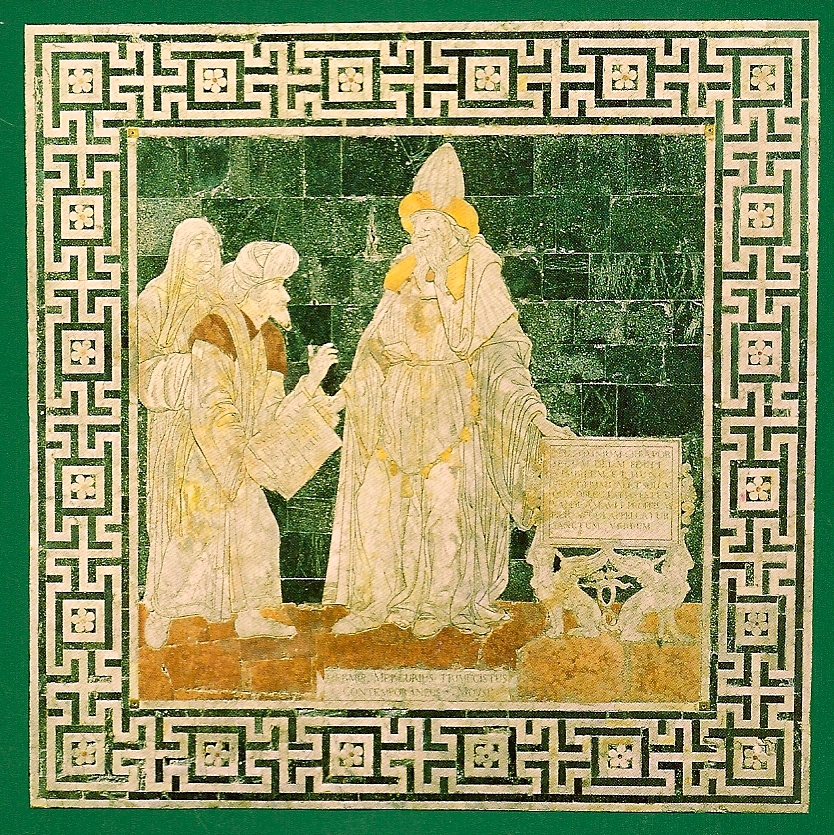
Corpus Hermeticum & Asclepius (Copenhaver Critical Edition)
The definitive scholarly translation of the Greek and Latin Hermetica attributed to Hermes Trismegistus, foundational to Renaissance Neoplatonism and Western esotericism.